NanoClaw comes to Slack, letting you create persistent AI agent teams and colleagues from a single message
ThinkingNews Desk · how this was written
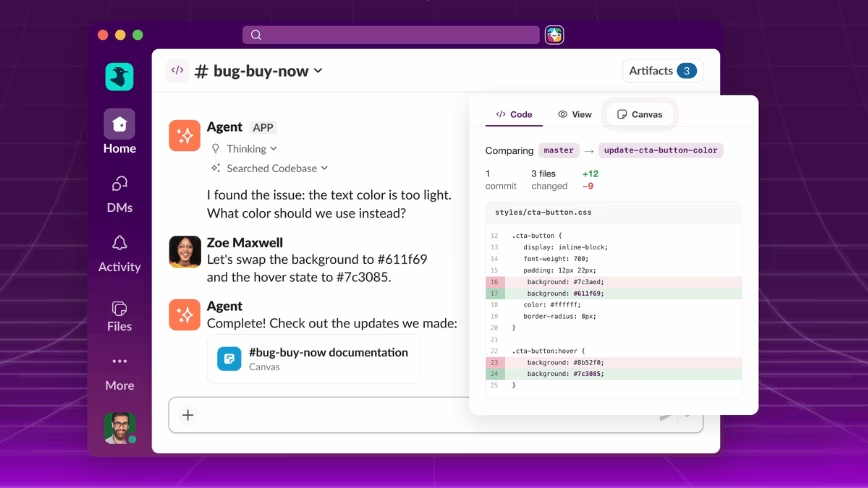
Slack has introduced Slack Code, a new feature that adds dedicated, project-specific channels where teams can work alongside AI coding agents that act like teammates. The feature, available on all Slack plans, lets users create persistent AI-agent teams and colleagues simply by sending a single message, enabling continuous collaboration between humans and AI.
Written from all 3 reports below, not from any single one.
How it was reported
- TechMeme·Slack launches Slack Code, adding dedicated, project-specific channels that let teams collaborate with AI coding agents "like teammates" across all Slack plans (Jess Weatherbed/The Verge)
Slack introduced Slack Code, a feature that creates dedicated, project-specific channels where teams can work with AI coding agents that behave like teammates. The new channels are available on every Slack plan, enabling collaborative code development and troubleshooting directly within the Slack workspace.
- The Next Web·Slack launches Slack Code, where teams and AI agents build together
Slack launched Slack Code, a feature that creates project-specific channels where teams and AI agents collaboratively write, review, and ship code within the chat app, using separate tabs for conversation, planning, diffs and live previews. The channel archives after completion, retains an audit log, and requires human sign-off for high-risk actions; agents from Anthropic, Cognition, GitHub, Vercel and OpenAI are available as separate purchases.
- VentureBeat·NanoClaw comes to Slack, letting you create persistent AI agent teams and colleagues from a single message
NanoCo’s new NanoClaw Slack integration lets users create persistent, autonomous AI agents with individual avatars, names, and memory contexts directly from a single Slack prompt, and these agents can collaborate in channels, Slack Canvases, and external platforms like Telegram and WhatsApp. The setup bypasses traditional Slack-bot development by using a one-time workspace connection, after which each agent is provisioned as its own Slack bot running on the customer’s infrastructure with tokens stored locally.
Related stories
- Jack Dorsey’s Block takes on Slack with Buzz, a workspace for humans and AI agents4 outlets
- Entire launches a distributed Git network built for AI coding agents4 outlets
- Mozilla dev's "Stack Overflow for agents" targets a key weakness in coding AI6 outlets
- Kimi K2.6 runs agents for days — and exposes the limits of enterprise orchestration5 outlets